


How to Read Sports Betting Odds: Implied Probability and Bookmaker Margin
Sports betting odds show how a wager is priced and what a winning bet would return. They can also be converted into an implied probability, which makes it easier to compare prices and spot the bookmaker’s margin. Knowing how to do the math does not predict an outcome, but it can help you understand what an odds display is actually telling you.
What odds tell you
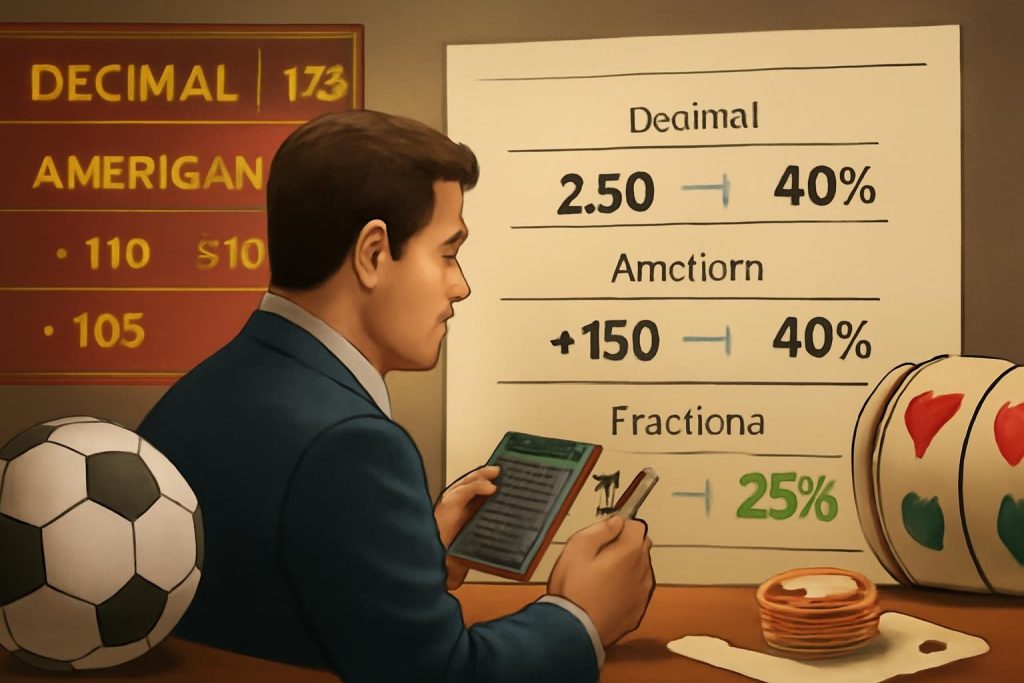
Odds express a potential return relative to a stake. The format varies by sportsbook: decimal odds are common in many regions, while American and fractional odds appear on other platforms. Each format can be translated into an implied probability—the probability suggested by the price before accounting for the bookmaker’s margin.
Implied probability is not an objective forecast. It is a way of interpreting the price, and bookmaker prices generally include a margin that makes the combined implied probabilities for all possible outcomes exceed 100%.
Convert decimal odds to implied probability
Decimal odds include your original stake in the total payout. To calculate the implied probability, divide 1 by the decimal odds, then multiply by 100.
- Formula: implied probability = 1 ÷ decimal odds × 100
- Example: odds of 2.50 imply 1 ÷ 2.50 × 100, or 40%.
A winning $10 stake at decimal odds of 2.50 would return $25 in total: the $10 stake plus $15 in winnings. That payout calculation does not mean the outcome has a true 40% chance of happening. It only shows the probability associated with that price before adjusting for margin.
Convert American and fractional odds
American odds use a plus or minus sign. Positive odds show the potential profit on a $100 stake; negative odds show how much you need to stake to make $100 in profit.
- Positive odds: implied probability = 100 ÷ (odds + 100). For +150, that is 100 ÷ 250, or 40%.
- Negative odds: use the absolute value of the odds: implied probability = odds ÷ (odds + 100). For -150, that is 150 ÷ 250, or 60%.
Fractional odds compare potential profit with stake. For odds of 5/2, the implied probability is 2 ÷ (5 + 2) × 100, or about 28.6%. As with the other formats, the stake is returned separately from the stated profit.
How to estimate the bookmaker’s margin
To see the margin in a market, convert the odds for every outcome into implied probabilities and add them. In a two-outcome market where both sides are priced at decimal odds of 1.91, each price implies about 52.36%. Together they total about 104.72%, which is 4.72 percentage points above 100%.
This excess is commonly called the overround. It indicates that the prices include a margin; it is not necessarily the bookmaker’s exact profit on a particular market. The actual result depends on factors such as how bets are distributed and whether the market outcome is settled as expected.
You can also make a simple proportional adjustment to compare the implied shares after accounting for the overround. Divide each outcome’s implied probability by the total. In the example, 52.36 divided by 104.72 gives 50% for each side. This is a mathematical normalization, not a guarantee that the outcomes are equally likely.
Common interpretation mistakes
- Treating probability as certainty: a price implying 70% still leaves room for the less likely outcome.
- Comparing formats without converting: translate prices into one format or implied probabilities first.
- Confusing payout with profit: decimal odds include the returned stake; American and fractional conventions need to be read differently.
- Ignoring the whole market: a single selection’s implied probability does not reveal the total overround.
Use odds as information, not a promise
Before placing any wager, check that you understand the format, the settlement rules and the amount at risk. Odds can change, and a calculation cannot remove uncertainty or make betting a reliable way to earn money. If you choose to gamble, set a limit you can afford to lose and stop when you reach it.
For broader context, see these guides to basic betting considerations, the limits of gambling strategies and how betting systems are discussed. Understanding prices is useful, but no system can guarantee an outcome.